Brand Name vs Company Name: Why the Difference Matters
Most people use “brand name” and “company name” interchangeably — but they’re not the same thing. Understanding the distinction between brand name vs company name is one of the most important naming decisions you’ll make as a founder, entrepreneur, or marketer. Getting it wrong leads to customer confusion, legal complications, and missed growth opportunities. Getting it right creates clarity, scalability, and brand power.
Consider this: When you buy a can of Pringles, you’re buying from a brand called Pringles — but the company behind it is Kellanova (formerly Kellogg’s). When you use Google Search, you’re using a product from Google LLC — but the company is now under Alphabet Inc. When you drink a Pepsi, the brand is Pepsi — but the company is PepsiCo, which also owns Lay’s, Gatorade, Quaker Oats, and dozens of other brands. This brand name vs company name distinction isn’t just semantics — it’s business architecture.
This guide breaks down exactly what separates a brand name from a company name, when they should be the same, when they should be different, and how to make the right choice for your specific situation. Drawing from real examples across industries, legal frameworks from the USPTO, and decades of branding strategy, this comprehensive comparison will give you the clarity to name both your brand and your company with confidence.
What Is a Company Name? The Legal Entity
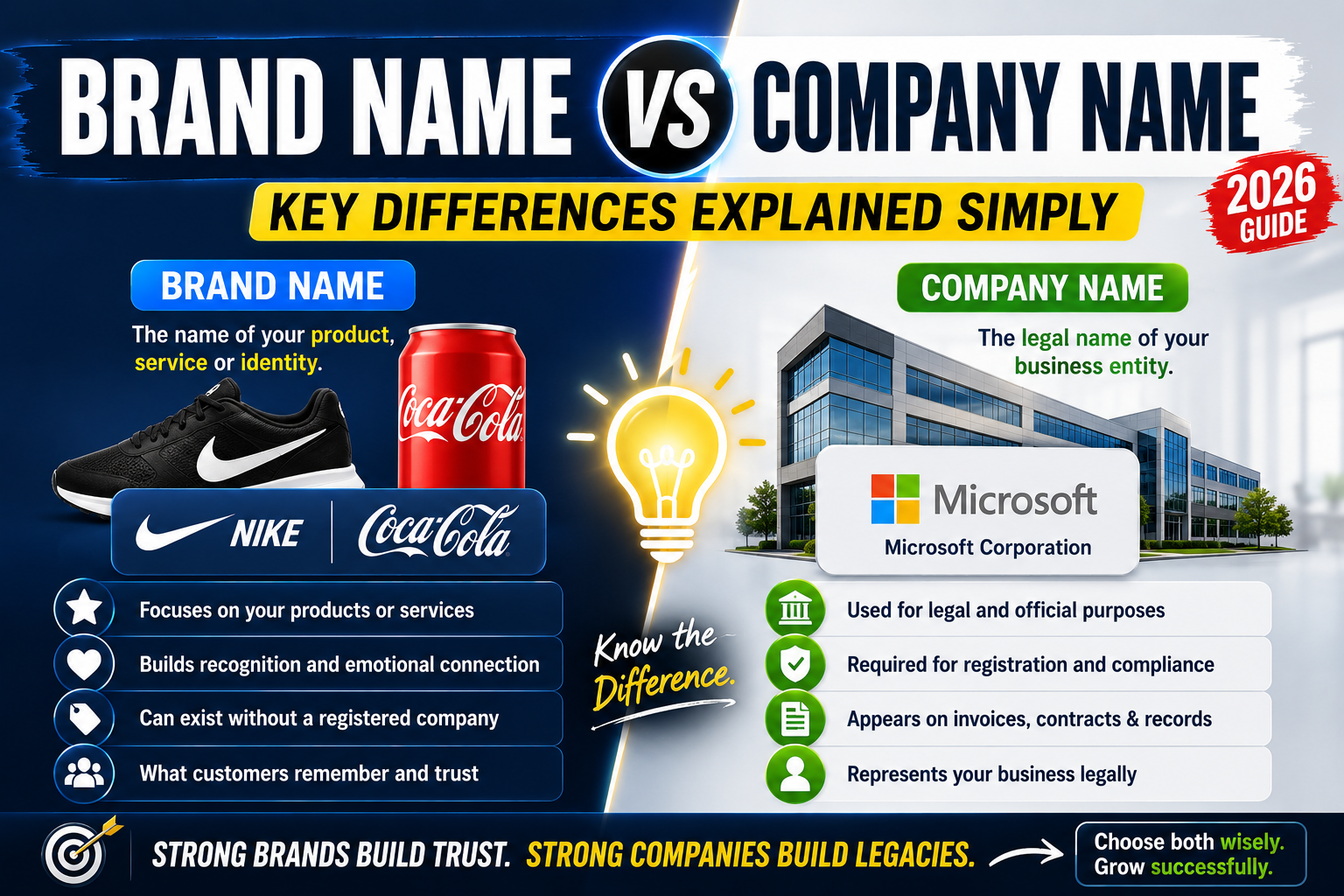
A company name is the legal name of your business entity — the name registered with government authorities, used on tax filings, contracts, bank accounts, and official documents. It’s the name that appears on your business license, your articles of incorporation, and your employer identification documents. When the IRS sends you a letter, it’s addressed to your company name. When you sign a lease or a vendor contract, you sign under your company name.
Key Characteristics of a Company Name:
⚖️ Legally Registered
A company name is registered with state, provincial, or national business registries. In the US, this means filing with your Secretary of State or equivalent agency. The name must be unique within your jurisdiction — you can’t incorporate “Apple Inc.” in California because that name is already registered. Company names often include legal designators like “Inc.,” “LLC,” “Ltd.,” “Corp.,” or “PLC” depending on your business structure and jurisdiction.
📋 Administrative Function
The company name serves primarily administrative and legal purposes. It appears on tax returns, employment records, regulatory filings, bank accounts, insurance policies, and contracts. It’s the entity that owns assets, enters legal agreements, and bears liability. The company name is for the government, the bank, and the legal system — not necessarily for customers.
🏢 Can Own Multiple Brands
A single company can own dozens or even hundreds of brand names. Procter & Gamble (company name) owns Tide, Pampers, Gillette, Crest, Olay, and over 60 other brands. Unilever (company name) owns Dove, Lipton, Hellmann’s, Ben & Jerry’s, and hundreds more. The company name is the parent entity; the brand names are the customer-facing identities.
🔒 Less Marketing-Driven
Company names don’t need to be catchy, memorable, or emotionally resonant. “International Business Machines Corporation” is a mouthful — but it works fine as a company name. The company eventually adopted “IBM” as its brand name because the full legal name was terrible for marketing. Many company names are deliberately descriptive or even generic because their audience is government agencies, not consumers.
What Is a Brand Name? The Customer-Facing Identity
A brand name is the customer-facing identity — the name that appears on your products, your website, your advertising, your social media, and in the minds of your customers. It’s what people search for on Google, recommend to friends, and build emotional connections with. When someone says “I love Apple products,” they’re talking about the brand — not the legal entity Apple Inc.
Key Characteristics of a Brand Name:
🧠 Emotionally Resonant
A brand name exists in the minds of consumers. It carries associations, emotions, expectations, and reputation. When you hear “Nike,” you don’t think about the legal entity Nike, Inc. — you think about athletic achievement, the swoosh logo, “Just Do It,” and perhaps specific athletes or shoes. Brand names build psychological connections that company names rarely achieve.
📢 Marketing-Focused
Brand names are designed for communication. They’re crafted to be memorable, pronounceable, distinctive, and emotionally appealing. They appear in advertising campaigns, on product packaging, in social media handles, and in word-of-mouth recommendations. A great brand name is easy to say, easy to remember, and easy to share — qualities that are optional for company names but essential for brand names.
🏷️ Trademark-Protected
Brand names are protected through trademark registration — separate from company name registration. A company can have one registered company name but dozens of registered trademarks for its various brand names. Trademarks protect the brand name in commerce, preventing competitors from using confusingly similar names for similar products or services. Trademark protection is category-specific: “Dove” is trademarked for both chocolate (Mars) and personal care (Unilever) because they’re in different product categories.
🔄 Can Exist Independently
A brand name can exist independently of the company name behind it. Most consumers don’t know that Ben & Jerry’s is owned by Unilever, that Lexus is owned by Toyota Motor Corporation, or that Instagram is owned by Meta Platforms, Inc. The brand operates with its own identity, audience, and marketing — the parent company remains in the background. This separation is strategic: it allows companies to target different market segments with different brand identities.
Brand Name vs Company Name: The Core Differences at a Glance
| Aspect | Company Name | Brand Name |
|---|---|---|
| Primary Purpose | Legal identification, administrative function | Customer recognition, marketing, emotional connection |
| Registration | Government business registry (state/national) | Trademark office (USPTO, EUIPO, etc.) |
| Audience | Government agencies, banks, legal entities, B2B partners | Consumers, customers, general public, media |
| Legal Designator | Often includes Inc., LLC, Ltd., Corp., PLC | Rarely includes legal designators (exceptions exist) |
| Quantity | One primary company name per legal entity | Multiple brands can exist under one company |
| Memorability | Optional — doesn’t need to be catchy | Essential — must be memorable and shareable |
| Emotional Appeal | Not required | Critical for consumer connection and loyalty |
| Change Frequency | Rarely changes — requires legal filings | Can evolve, rebrand, or launch new brands |
| Example | Alphabet Inc., PepsiCo, Inc., Meta Platforms, Inc. | Google, Pepsi, Instagram |
Real-World Examples: Brand Name vs Company Name in Action
The best way to understand brand name vs company name is through real examples. These companies illustrate the different strategic approaches to naming — and what each approach achieves:
When the Company Name and Brand Name Are the Same
Many businesses — especially startups and small businesses — use the same name for both their company and their brand. This is the simplest approach and works well when you have one primary product or service, and your company’s reputation is your brand’s reputation.
| Company Name | Brand Name | Why It Works |
|---|---|---|
| Apple Inc. | Apple | Apple sells products under the Apple brand. The company and the brand are inseparable. Every product — iPhone, Mac, iPad — carries the Apple brand. The simplicity of one name for everything reinforces brand cohesion and makes trademark protection straightforward. |
| Nike, Inc. | Nike | Nike is both the company and the brand. Air Jordan is a sub-brand, but it’s always “Air Jordan by Nike.” The parent brand dominates. This unified approach builds enormous brand equity concentrated in a single name. |
| Netflix, Inc. | Netflix | Netflix operates as both the company and the single service brand. There’s no separate company name behind the scenes. This works because Netflix has one core offering — even as they expand into gaming and live events, everything is under the Netflix umbrella. |
| Spotify Technology S.A. | Spotify | Spotify is another example of a unified company/brand name. The legal entity includes “Technology S.A.” (the Luxembourg designation), but the brand is simply “Spotify.” This simplicity is common for single-product tech companies. |
When the Company Name and Brand Names Are Different
Larger companies — especially those with multiple product lines, acquisitions, or diverse market segments — often maintain a separate company name that differs from their consumer-facing brands. This architecture allows each brand to target different audiences without confusing the market.
| Company Name | Brand Names It Owns | Strategic Reason |
|---|---|---|
| Procter & Gamble | Tide, Pampers, Gillette, Crest, Olay, Febreze, Bounty, Charmin, Dawn, Old Spice | P&G is a house of brands. Each brand targets a specific market segment with its own identity, positioning, and customer base. Consumers build loyalty to Tide, not to P&G. This allows P&G to own multiple brands in the same category (laundry detergent: Tide, Gain, Cheer) without confusing consumers. |
| Unilever | Dove, Lipton, Hellmann’s, Ben & Jerry’s, Knorr, Magnum, Vaseline, TRESemmé | Similar house of brands strategy. Unilever’s company name is virtually unknown to consumers — and that’s intentional. Each brand competes on its own merits. If one brand faces controversy, it doesn’t necessarily damage the others or the parent company. |
| Alphabet Inc. | Google, YouTube, Waymo, DeepMind, Verily, Calico | Google restructured under Alphabet to separate its core internet business (Google) from its moonshot ventures (Waymo, Verily). Alphabet is the company; Google is a brand within it. Investors buy Alphabet stock; consumers use Google products. This structure provides clarity for both audiences. |
| Meta Platforms, Inc. | Facebook, Instagram, WhatsApp, Threads, Oculus | Facebook rebranded its company name to Meta to signal a shift toward the metaverse while keeping its social media brands (Facebook, Instagram, WhatsApp) separate. Each brand maintains its own identity; the parent company name signals a broader vision. |
When Should Your Brand Name and Company Name Be the Same?
For most startups, small businesses, and single-product companies, keeping the brand name vs company name the same is the right move. Here’s when a unified naming strategy makes sense:
🚀 Early-Stage Startups
When you’re launching your first product, simplicity wins. Using the same name for your company and brand reduces confusion, simplifies trademark filing (one registration covers both), and builds concentrated brand equity. Every mention of your company builds your brand, and vice versa. Most Y Combinator startups follow this model.
🎯 Single Product or Service
If your company does one thing, one name is usually sufficient. Stripe is both the company and the payment processing brand. Notion is both the company and the productivity software brand. When your product and your company are essentially the same thing, separate names add unnecessary complexity.
💪 Strong, Brandable Company Name
If your company name is already short, memorable, distinctive, and emotionally appealing, use it as your brand name too. “Apple,” “Nike,” “Tesla,” and “Zoom” work brilliantly as both company and brand names. If your company name passes the brand name test, there’s no need to create a separate brand identity.
📣 Marketing Efficiency
Building one name is more efficient than building two. Every dollar spent marketing your brand also builds your company’s reputation. Every press mention reinforces both entities simultaneously. For resource-constrained startups and small businesses, this efficiency is significant.
When Should Your Brand Name and Company Name Be Different?
As businesses grow, diversify, or target different markets, separating the company name from brand names becomes strategically valuable. Here’s when the distinction between brand name vs company name matters most:
🏢 Multiple Product Lines
When you sell products in different categories or at different price points, separate brand names prevent cannibalization and confusion. Toyota (company) sells both the Toyota Corolla (affordable) and the Lexus LS (luxury). If Lexus were called the “Toyota Luxury Sedan,” it couldn’t command premium pricing. Separate brands create distinct market positions.
🎯 Different Target Audiences
When your products serve fundamentally different customer segments, separate brand identities communicate more effectively. Gap Inc. (company) owns Old Navy (value-conscious families), Gap (mainstream), Banana Republic (affordable luxury), and Athleta (athletic women). Each brand speaks to its audience in its own voice.
🤝 Acquisitions and Mergers
When a company acquires another business, the acquired brand often retains its name for continuity and customer loyalty. When Microsoft acquired LinkedIn, LinkedIn kept its brand. When Amazon acquired Whole Foods, Whole Foods kept its brand. The parent company benefits from the brand equity that already exists — rebranding would destroy value.
🛡️ Risk Management
Separating company and brand names creates a liability buffer. If one brand faces a scandal, product recall, or reputational crisis, the damage is contained to that brand rather than spreading to the entire company. P&G can weather a Tide recall without it affecting Pampers sales because consumers don’t connect the two brands.
🌍 International Markets
Brand names that work in one country may not work in another due to language, cultural, or trademark issues. A separate company name allows you to operate different brand names in different markets while maintaining one legal entity. This is common in food, beverage, and consumer goods industries.
🔄 Future Sale or Exit
If you might eventually sell individual product lines or brands, keeping them separate from the company name makes the transaction cleaner. You can sell a brand without selling the entire company. Venture-backed startups with multiple products often structure their brands for potential divestiture.
Legal Considerations: Brand Name vs Company Name Registration
Understanding the legal differences between brand name vs company name is essential for protecting your business. These are separate registration processes with different agencies and different scopes of protection:
Company Name Registration:
- Where: State or national business registry (Secretary of State in the US, Companies House in the UK, etc.)
- Scope: Protects the name within your jurisdiction — prevents another company from incorporating with an identical or confusingly similar name in the same state or country
- Limitations: Does NOT prevent someone from using the name as a brand in commerce. A company name registration in Delaware doesn’t stop someone from selling products under that name in California.
- Renewal: Ongoing through annual reports and franchise taxes
- Cost: Varies by state/country; typically $50-$800 for initial registration
Brand Name (Trademark) Registration:
- Where: Trademark office (USPTO in the US, EUIPO in the EU, etc.)
- Scope: Protects the name in commerce within specific product/service categories (classes). Prevents competitors from using confusingly similar names for similar goods or services.
- Limitations: Category-specific. “Dove” is trademarked for both chocolate (Class 30) and soap (Class 3) by different companies because they’re in unrelated categories.
- Renewal: Requires maintenance filings between years 5-6 and renewal every 10 years
- Cost: USPTO filing fees $250-$350 per class; attorney fees additional
How to Choose: A Decision Framework for Brand Name vs Company Name
Use this step-by-step framework to determine whether your brand name vs company name should be the same or different:
Count Your Products or Services
Do you have one core offering, or multiple distinct products/services targeting different audiences or price points? One product → unified name usually works. Multiple diverse products → consider separate brand names under one company.
Define Your Growth Strategy
Will you grow organically (developing new products under your existing identity) or through acquisition (buying other companies/brands)? Organic growth favors unified naming. Acquisition growth favors separate brand names to preserve acquired brand equity.
Evaluate Your Company Name’s Brand Potential
Is your company name short, memorable, distinctive, and emotionally appealing? Use our brand name scorer to evaluate. If it scores well as a brand name, use it for both. If it’s descriptive, generic, or hard to remember, create a separate brand name.
Consider Your Exit Strategy
Do you plan to sell the entire company, or might you sell individual products/brands separately? If individual brand sales are possible, keep brand names distinct from the company name for cleaner transactions.
Assess Risk Tolerance
How damaging would a brand crisis be? If reputation risk is high (food, health, finance, children’s products), separating company and brand names creates a buffer. One brand’s problem shouldn’t sink the entire company.
Check Availability
Whatever you choose, verify that both your company name (in your jurisdiction) and your brand name (as a trademark in your category) are available. A great brand name means nothing if you can’t legally register the company or secure the trademark.
Common Mistakes in Brand Name vs Company Name Decisions
Mistake #1: Assuming Company Registration Protects Your Brand
You incorporate “ZenTech Solutions Inc.” and assume no one else can use “ZenTech.” Wrong. Company registration protects against another company incorporating with the same name in your state — nothing more. Someone could trademark “ZenTech” for software and sell competing products under that name. Fix: Register your company name AND file for trademark protection on your brand name. They’re separate processes for separate purposes.
Mistake #2: Using a Generic Company Name as Your Brand
“International Digital Marketing Solutions LLC” might work as a company name, but as a brand name, it’s invisible. Customers won’t remember it. They won’t search for it. They won’t recommend it. Fix: Create a brandable name for customer-facing purposes even if your company name is descriptive. “IDMS” could become the brand “Amply” or “Reachora” — something distinctive and memorable.
Mistake #3: Creating Unnecessary Complexity Too Early
Pre-revenue startups sometimes create elaborate corporate structures with a parent company and multiple brand names for products that don’t exist yet. This is premature optimization. Fix: Start simple. One name for everything. Add complexity — separate brands, sub-brands, parent companies — only when your business genuinely needs it. Most startups never reach the scale where separate company and brand names are necessary.
Mistake #4: Ignoring International Implications
Your company name works in English, but your brand name means something unfortunate in Spanish, sounds like a curse word in Mandarin, or can’t be pronounced in Japanese. Fix: If you plan to operate internationally, check both your company name and brand name in target market languages. A name that’s offensive or unpronounceable in a key market creates unnecessary barriers.
Mistake #5: Changing Either Name Without a Strategy
Rebranding a company name requires legal filings, new bank accounts, updated contracts, and regulatory notifications. Rebranding a brand name requires new marketing materials, customer communication, and trademark updates. Both are disruptive — but rebranding a brand is generally easier than rebranding a company. Fix: Invest time upfront to choose names that can grow with your business. The cost of changing either name later is far higher than the cost of getting it right initially.
Frequently Asked Questions About Brand Name vs Company Name
Can my brand name and company name be exactly the same?
Yes — and this is the most common approach for startups and small businesses. Apple Inc. and the brand “Apple” are the same. Nike, Inc. and the brand “Nike” are the same. This unified approach simplifies branding, marketing, and legal protection. The key is ensuring your company name is also brandable — short, memorable, distinctive, and emotionally appealing. If your company name is “Johnson & Associates Consulting LLC,” you might want a separate brand name for customer-facing purposes. Use our brand name scorer to evaluate whether your company name works as a brand name.
Do I need a “Doing Business As” (DBA) if my brand name is different from my company name?
In most jurisdictions, yes. A DBA (also called a fictitious business name or trade name) allows you to operate under a name different from your legal company name. If your company is “Smith Enterprises LLC” but you want to operate a brand called “CloudCraft,” you’ll need to file a DBA for “CloudCraft” with your local or state government. This allows you to open bank accounts, sign contracts, and receive payments under the brand name while maintaining your legal entity. DBA requirements vary by jurisdiction — check your local regulations. Note that a DBA provides NO trademark protection; it’s purely an administrative registration.
Which should I register first — company name or trademark?
Ideally, check availability for both simultaneously. You don’t want to incorporate under a name, only to discover the trademark is unavailable — or file a trademark, only to discover you can’t register the company name in your jurisdiction. The recommended sequence: (1) Brainstorm names. (2) Check company name availability in your jurisdiction and trademark availability in your category simultaneously. (3) If both are available for your chosen name, register the company name first (to establish the legal entity) and file the trademark application immediately after. For more on this process, read our complete naming guide.
How do large companies manage so many brand names?
Large companies use a “brand architecture” system — a structured hierarchy that defines relationships between the company name and its various brands. Common architectures include: (1) Branded House — one master brand with sub-brands (Google: Google Search, Google Maps, Google Drive). (2) House of Brands — a parent company with independently branded products (P&G: Tide, Pampers, Gillette). (3) Endorsed Brands — sub-brands that carry the parent brand’s endorsement (Marriott: Courtyard by Marriott, Residence Inn by Marriott). (4) Hybrid — a mix of approaches based on product category and market strategy. The right architecture depends on your product diversity, target audiences, and growth strategy.
Can I change my company name or brand name later?
Yes, but the difficulty varies significantly. Changing a brand name is challenging but manageable — it requires new marketing materials, customer communication, updated trademark filings, and a transition period where both names may need to coexist. Many companies have successfully rebranded (Google → Alphabet for the parent company, Facebook → Meta). Changing a company name is more administratively complex — it requires legal filings, new bank accounts, updated contracts, IRS notification, and potentially new EIN application. It’s far better to invest the time upfront to choose the right names than to change them later. That said, if you must change, it’s possible — and sometimes strategically necessary.
Tools to Help You Navigate Brand Name vs Company Name Decisions
NameSpark offers free tools specifically designed to help you evaluate and choose both brand names and company names:
📊 Brand Name Scorer
Evaluate any name on memorability, distinctiveness, pronunciation ease, and brandability. See if your company name works as a brand name.
🤖 Business Name Generator
Generate brandable business names that work as both company names and brand names. AI-powered suggestions with domain checks.
🔍 Domain Checker
Check domain availability for your company name and brand names across .com, .co, .io, and 20+ TLDs.
📱 Social Handle Checker
Verify social media username availability for your brand name across all major platforms.
⚡ Name Comparison
Compare multiple name ideas side by side with scoring, availability, and suitability for company vs brand use.
🔊 Pronunciation Tool
Hear how your brand name sounds aloud. Essential for evaluating memorability and shareability.
Conclusion: Clarity Creates Brand Power
The distinction between brand name vs company name isn’t just legal technicality — it’s strategic architecture. Understanding when these names should be the same and when they should be different is a foundational business decision that impacts everything from marketing efficiency to risk management to exit strategy.
For most startups, small businesses, and single-product companies, a unified name works best. It’s simpler, more efficient, and builds concentrated brand equity. For growing companies with diverse products, different target audiences, or acquisition-based growth strategies, separate company and brand names provide flexibility, risk protection, and market positioning advantages.
Whatever approach you choose, invest the time to get both names right. A great company name makes legal and administrative life easier. A great brand name makes marketing and customer relationships flourish. And when you can achieve both with one exceptional name, you’ve built a foundation for decades of growth.
Score your brand name now → — free, instant, no account required.
Then explore our business name generator to find names that work brilliantly as both company names and brand names. Your naming clarity starts here.