Last Updated: January 15, 2026
How AI Name Generators Work: The Technology Behind the Magic
You type a few words — “a modern SaaS startup for remote teams” — and within seconds, an AI name generator produces dozens of relevant, creative, and surprisingly good name suggestions. “TeamSync.” “RemoteFlow.” “CollabNest.” “WorkWave.” Some even come with domain availability checks, pronunciation guides, and brand scores. It feels like magic. But how AI name generators work is not magic — it’s a fascinating combination of natural language processing, machine learning, and clever engineering that’s been decades in the making.
At their core, AI name generators are specialized applications of large language models (LLMs) — the same underlying technology that powers ChatGPT, Google Gemini, and other AI systems that have transformed how we interact with computers. But while general-purpose AI chatbots can do many things, name generators are fine-tuned for one specific, challenging task: creating names that are simultaneously creative, relevant, memorable, and available. This guide pulls back the curtain on exactly how AI name generators work, from training data to output generation, so you can understand — and better use — these powerful creative tools.
Drawing from research published by Google’s Transformer research team, OpenAI’s language model papers, and practical engineering insights from building NameSpark’s own AI naming engine, this guide explains the technology in clear, accessible terms. Whether you’re a curious user, a developer building naming tools, or someone who just wants to understand why the AI sometimes suggests “FluffyBunny” for a law firm, this comprehensive explanation has you covered.
The Foundation: Large Language Models and How They Understand Words
To understand how AI name generators work, you first need to understand the foundation they’re built on: large language models (LLMs). These are neural networks — computer systems loosely inspired by the human brain — that have been trained on enormous quantities of text from the internet, books, articles, and other sources. During training, the model learns patterns: how words relate to each other, what words typically appear together, how sentences are structured, and — critically for name generation — what makes certain combinations of sounds and letters feel “right” for different contexts.
Key Concepts in Language Models:
🧠 Tokenization
Before an AI can process text, it breaks words into smaller pieces called tokens. A token might be a whole word (“startup”), a part of a word (“start” + “up”), or even individual characters. The model learns relationships between these tokens — which tokens tend to follow others, which combinations are common, and which are rare. This token-level understanding is what allows AI to generate entirely new words that sound plausible because they follow the same token patterns as real words.
🔗 Attention Mechanisms
The breakthrough that made modern AI possible was the attention mechanism, introduced in Google’s 2017 paper “Attention Is All You Need.” Attention allows the model to weigh the importance of different words in a sequence when generating the next word. When you type “a fantasy character name for an elf,” the model pays more attention to “fantasy,” “elf,” and “character” than to “a” or “for.” This targeted focus enables contextually relevant name generation.
📊 Embeddings
Words and tokens are converted into mathematical vectors called embeddings — essentially, coordinates in a high-dimensional space where similar concepts are positioned near each other. “King” and “Queen” are close together. “Pizza” and “Pasta” are neighbors. “Startup” and “Venture” sit in the same neighborhood. When generating names, the AI navigates this semantic space to find words and word-parts that cluster around your described concept.
🔄 Next-Token Prediction
At its simplest level, a language model is a next-token prediction machine. Given a sequence of tokens, it predicts the most likely next token. “The cat sat on the ___” → “mat.” For name generation, the model predicts the next character or syllable in a name, constrained by the patterns it learned during training. This is why AI-generated names follow recognizable linguistic patterns — the model learned that “NovaTech” is a plausible name construction while “Xqzptlk” is not.
Training Data: What AI Name Generators Learn From
A critical part of understanding how AI name generators work is knowing what they’re trained on. The quality, diversity, and relevance of training data directly determines the quality of generated names. An AI name generator trained only on 1990s business names will produce very different suggestions than one trained on diverse, contemporary naming data across multiple categories.
Types of Training Data for Name Generation:
🏢 Business & Brand Names
Real company names from Crunchbase, AngelList, SEC filings, and business registries. Brand names from trademark databases. Product names from e-commerce platforms. This data teaches the AI patterns in successful business naming — short, memorable constructions, common prefixes and suffixes, and industry-specific naming conventions.
🐉 Fantasy & Gaming Names
Character names from published fiction, RPG sourcebooks, gaming platforms, and fan communities. Elven names from Tolkien’s works. D&D character names from official materials. Gamertags from Xbox, PlayStation, and Steam. This data teaches race-specific phonetic patterns and genre conventions.
👤 Real-World Names
Names from census data, birth registries, and cultural naming databases across 50+ traditions. Japanese names with kanji meanings. Arabic names with linguistic roots. African names with tribal significance. This data teaches culturally authentic naming patterns rather than stereotyped approximations.
📚 Linguistic Data
Phonetic patterns, syllable structures, and morphological rules from multiple languages. Common prefixes and suffixes across language families. Sound symbolism research — which sounds convey “small,” “fast,” “strong,” or “gentle.” This data enables the AI to generate names that feel phonetically appropriate for their intended category.
🏷️ Domain & Availability Data
Patterns in domain name availability, common TLD usage, and naming trends in registered domains. Social media handle patterns. This data helps the AI understand what makes a name “available” and steers generation toward names more likely to have open domains and handles.
📈 Trend Data
Year-over-year naming trends from brand databases, baby name rankings, startup naming patterns, and cultural trend analysis. This data helps the AI understand what feels contemporary versus dated — why “Tumblr” feels 2010s while “Nova” feels timeless.
From Input to Output: The Name Generation Pipeline
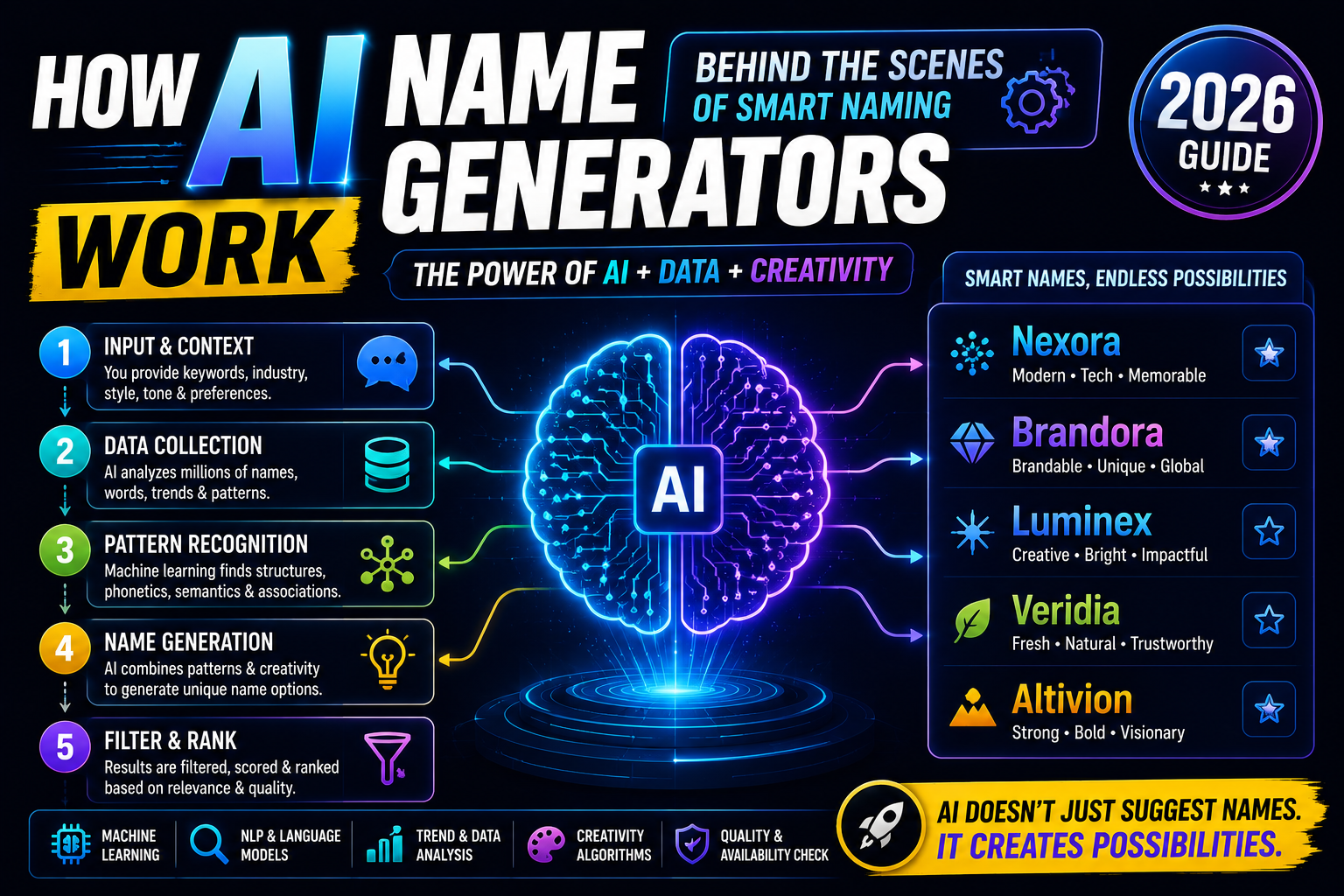
When you type “a modern fintech startup” into an AI name generator, what actually happens between clicking “Generate” and seeing results? Understanding this pipeline is central to how AI name generators work. Here’s the step-by-step process:
Input Parsing and Intent Detection
Your input text is analyzed to extract key information: the category (business, character, pet, gaming), the industry or genre (fintech, fantasy, SaaS), the tone (professional, playful, luxurious, futuristic), and any specific constraints (must start with “N,” should be 2 syllables). Named entity recognition identifies important terms. Sentiment analysis gauges the emotional direction. This parsing step determines which specialized model or parameters to activate for generation.
Context Vector Construction
The parsed input is converted into a dense mathematical representation — a context vector — that captures the semantic meaning of your request. “Modern fintech startup” maps to a specific region in the embedding space that’s near concepts like “finance,” “technology,” “innovation,” “digital,” and “trust.” This vector becomes the “prompt” that guides the generation process.
Constrained Token Generation
The language model generates name candidates token by token, but with important constraints applied: length constraints (prefer 2-3 syllable names for business), phonetic constraints (use sounds appropriate for the category), category-specific patterns (tech startups often use certain prefixes/suffixes), and diversity constraints (ensure generated names don’t all sound the same). The model predicts the next most likely token given the context and constraints, building each name character by character or syllable by syllable.
Post-Generation Filtering and Scoring
Raw generated names go through multiple filters: profanity and inappropriate content filters remove problematic suggestions, trademark conflict filters flag names too similar to existing brands, phonetic quality scoring evaluates ease of pronunciation, memorability scoring predicts recall likelihood, and category relevance scoring ensures the name fits the requested context. Names that pass all filters are ranked and the top candidates move forward.
Availability Checking (Optional but Common)
For business and brand names, the top candidates are checked against domain availability databases (WHOIS lookups), social media platform APIs (handle availability), and sometimes trademark databases. This step doesn’t affect the creative quality of names but dramatically increases their practical usefulness. The best name is useless if the domain is unavailable.
Results Presentation with Rationale
The final names are presented to the user, often with additional context: name rationale explaining why the name fits the request, domain availability indicators, pronunciation guides, and brand scores. This layer transforms raw AI output into actionable, decision-ready suggestions. Advanced generators like NameSpark include these features to help users not just see names but understand why they work.
How AI Understands Context, Tone, and Category
One of the most impressive aspects of how AI name generators work is their ability to adapt to different contexts. The same underlying technology can generate “Aerindor Starlight” for a fantasy elf, “NovaTech Solutions” for a SaaS startup, and “Biscuit” for a golden retriever puppy. How does the AI know which style to use?
Context Understanding Mechanisms:
🎯 Category-Specific Fine-Tuning
Advanced AI name generators use multiple specialized models or model adapters — one fine-tuned on business names, another on fantasy names, another on pet names. When the input parser detects your category, it routes the generation request to the appropriate specialized model. This is why the same AI can produce both “Quantum Dynamics LLC” and “Sparklewhiskers the Magnificent” — different models with different training data and different generation parameters handle each request.
🎭 Tone Embeddings
Words carry tonal associations that the AI learns during training. “Professional,” “luxurious,” “playful,” “futuristic,” “trustworthy” — these tone descriptors map to different regions in the embedding space. When you specify a tone, the AI biases generation toward names that cluster near that tonal region. A “playful” pet name will use different phonetic patterns than a “dignified” pet name, even within the same category.
🔤 Phonetic Pattern Recognition
Different naming categories have distinct phonetic fingerprints that the AI learns from training data. Tech startup names favor sharp consonants and front vowels (Stripe, Slack, Zapier). Luxury brand names favor open vowels and soft consonants (Armani, Gucci, Lexus). Fantasy elf names favor liquid consonants and flowing vowels (Elrond, Galadriel, Aerendir). The AI learns these patterns statistically and reproduces them when generating for each category.
📏 Structural Templates
Beyond individual sounds, the AI learns structural patterns: business names often use compound words (Salesforce, Facebook) or modified words (Spotify, Shopify). Fantasy names often use specific prefixes and suffixes (-iel, -ion, -wyn for elves; -in, -or, -im for dwarves). Gaming names often combine adjectives and nouns (ShadowBlade, StormBreaker). These structural templates guide the overall architecture of generated names, not just individual character choices.
The Secret Sauce: What Makes AI Name Generators Creative
Creativity seems uniquely human. How can a machine — which fundamentally just predicts the next most likely token — produce names that feel genuinely creative, surprising, and original? This question gets to the heart of how AI name generators work as creative tools rather than just pattern-matching engines.
Mechanisms That Enable AI Creativity in Naming:
🌡️ Temperature Sampling
The “temperature” parameter controls how predictable versus creative the AI’s output is. Low temperature (0.1-0.3) produces safe, expected names — common word combinations the model is very confident about. High temperature (0.7-1.0) produces more surprising, creative names by occasionally selecting less-likely tokens. The best AI name generators dynamically adjust temperature to balance creativity with relevance.
🎲 Stochastic Generation
AI name generators don’t deterministically produce the same output for the same input. They incorporate controlled randomness — each generation run explores a different path through the possibility space. This is why you get different name suggestions each time you click “Generate” even with the same input. The randomness is constrained by the context and category, so it explores relevant possibilities rather than truly random strings.
🔀 Cross-Category Blending
Modern AI name generators can blend patterns from multiple domains. A request for “a luxury pet brand” might blend phonetic patterns from luxury fashion naming with structural patterns from pet product naming. This cross-pollination produces genuinely novel combinations — names that feel simultaneously premium and pet-appropriate — something rule-based generators could never achieve.
AI Name Generators vs Rule-Based Generators: What’s the Difference?
Not all name generators use AI. Understanding the difference between AI-powered and rule-based generators is essential for evaluating tools and understanding how AI name generators work compared to their predecessors:
| Feature | Rule-Based Generators | AI-Powered Generators |
|---|---|---|
| How They Work | Combine words from pre-defined lists using fixed rules (Prefix + Suffix, Adjective + Noun) | Generate names using neural networks trained on millions of examples, understanding context and patterns |
| Creativity | Limited to combinations of words in the database. Cannot create truly new words. | Can generate entirely novel names that don’t exist in any database by learning underlying phonetic and structural patterns |
| Context Understanding | Minimal — matches keywords to pre-defined categories. “Tech startup” maps to a tech word list. | Deep — understands nuance. “Sustainable fashion brand for Gen Z” generates fundamentally different names than “luxury fashion brand for executives.” |
| Adaptability | Requires manual updates to word lists and rules for new categories or trends | Can be fine-tuned on new data; adapts to emerging naming conventions without explicit rule changes |
| Cultural Authenticity | Often produces stereotyped or inaccurate “cultural” names by combining random elements | Trained on authentic cultural naming data, producing names that respect real linguistic and cultural patterns |
| Example Output | “Tech” + “Solutions” = “TechSolutions” (predictable, generic) | “A modern SaaS startup” → “Driftdeck,” “Nodal,” “Pulsework” (creative, distinctive) |
Limitations: What AI Name Generators Can’t Do (Yet)
Understanding how AI name generators work also means understanding their limitations. These tools are powerful but not omniscient. Knowing what they can’t do helps you use them more effectively:
❌ Guarantee Trademark Availability
AI can flag names that are identical to known trademarks, but it can’t perform comprehensive trademark clearance. Trademark law is complex — similar-sounding names, names in related industries, and unregistered but legally protected marks may all create conflicts that the AI can’t detect. Always conduct a professional trademark search before using any name commercially.
❌ Understand Legal Nuance
AI doesn’t understand the legal implications of naming — what constitutes trademark infringement, what names are restricted in certain industries (finance, healthcare, legal), or what naming regulations apply in different jurisdictions. The AI generates creative suggestions; legal vetting remains a human responsibility.
❌ Predict Cultural Backlash
Names that seem perfectly fine to an AI can carry unintended meanings, offensive connotations, or cultural insensitivity that only humans with cultural knowledge can detect. AI trained on diverse data is better at avoiding obvious pitfalls, but it can’t guarantee cultural appropriateness across all contexts and communities.
❌ Replace Human Judgment
The AI generates options — it doesn’t make final decisions. It can’t know your personal taste, your team’s internal dynamics, your industry’s unwritten rules, or your gut feeling about a name. The best AI name generators are creative partners, not decision-makers. The final choice should always involve human judgment, testing with your target audience, and ideally, sitting with the name for at least 48 hours before committing.
How to Get the Best Results from AI Name Generators
Now that you understand how AI name generators work, you can use them more effectively. The quality of your input dramatically affects the quality of the output. Here’s how to write prompts that get the best results:
Be Specific About Category and Context
Instead of “name for a business,” try “name for a B2B SaaS company that helps remote teams collaborate asynchronously.” Instead of “fantasy name,” try “name for a wood elf ranger in a dark fantasy setting who specializes in archery.” The more context you provide, the more relevant the AI’s suggestions will be. Category + industry + tone + specific details = dramatically better results.
Specify Tone and Style
Add tone descriptors: “professional and trustworthy,” “playful and approachable,” “luxurious and exclusive,” “futuristic and innovative.” These words activate different regions of the AI’s embedding space, steering generation toward names with the right phonetic and structural characteristics for your desired tone.
Include Constraints (When Helpful)
If you have specific requirements, include them: “2-3 syllables,” “must start with ‘N’,” “should evoke speed and efficiency,” “avoid anything that sounds corporate.” The AI can incorporate these constraints into its generation process, narrowing the output to names that meet your criteria.
Generate Multiple Batches
Don’t settle for the first set of results. AI name generators incorporate randomness — each generation explores a different path through the possibility space. Run 3-5 batches with the same prompt to see a wider range of creative options. The perfect name might be in batch 4.
Iterate Based on What You Like
When you see names that are close to what you want but not quite there, use them as inspiration for a refined prompt. “I like the sound of ‘NovaTech’ but want something shorter” becomes a new prompt. Most AI name generators (including NameSpark) learn from your refinements and improve suggestions over successive generations.
The Future of AI Name Generation
As we look ahead, how AI name generators work will continue to evolve rapidly. Several emerging trends point toward even more powerful naming tools in the near future:
🧠 Multimodal Naming
Future AI name generators may accept images, mood boards, or brand color palettes as input alongside text descriptions. Upload your logo concept or visual inspiration, and the AI generates names that phonetically and semantically match the visual identity. This bridges the gap between visual branding and verbal identity.
🌍 Real-Time Cultural Validation
As AI models become more culturally sophisticated, name generators will provide real-time feedback on how a name might be perceived across different cultures, languages, and communities — flagging potential issues before you fall in love with a problematic name.
🔗 Deeper Integration
AI name generators will integrate more deeply with the full naming workflow: instant trademark pre-screening, automated domain registration, social handle securing, and even brand voice generation that extends the name into taglines, mission statements, and brand stories — all from a single initial prompt.
Frequently Asked Questions About How AI Name Generators Work
Are AI-generated names actually unique?
They can be. Because AI name generators learn underlying patterns rather than simply combining existing words, they can generate names that have never existed before. “Zapnix,” “Quorva,” “Brimble” — these are statistically plausible as names based on learned patterns, but they may never have appeared in any database. However, because the AI is trained on real names, it can also generate names that coincidentally match existing companies or brands. This is why availability checking is essential — uniqueness in the AI’s output doesn’t guarantee uniqueness in the real world.
Do AI name generators copy existing names?
Good AI name generators are designed not to directly reproduce names from their training data. They learn patterns, not memorized lists. However, for very common or famous names, the patterns may be so strong that the AI occasionally generates something very similar. This is why post-generation filtering against known trademarks and existing brands is a critical step in the pipeline. NameSpark’s filtering system actively removes generated names that are too similar to major existing brands.
Why do AI name generators sometimes produce strange results?
Because they’re probabilistic systems, not deterministic ones. The randomness that enables creativity also occasionally produces duds — names that are phonetically awkward, unintentionally funny, or just don’t work. This is why modern AI name generators include multiple quality filters and scoring systems that catch most poor suggestions before they reach the user. If you occasionally see a strange result, it’s usually because the temperature was set high for creativity and that particular random path didn’t work out. Just generate again.
Can AI name generators replace human naming agencies?
For many use cases, yes — especially for startups, small businesses, indie creators, and personal projects where a $25,000 naming agency engagement isn’t feasible. AI name generators democratize access to creative naming, producing suggestions that would have required expensive professional services a decade ago. However, for Fortune 500 companies, global product launches, and situations where comprehensive trademark clearance and multi-market linguistic analysis are critical, human naming agencies still provide value that AI can’t fully replicate — particularly in strategic positioning, stakeholder management, and legal vetting. The most likely future is hybrid: AI generates a broad creative pool; humans refine, test, and validate the final selection.
How does NameSpark’s AI name generator specifically work?
NameSpark uses a custom fine-tuned language model trained on millions of names across 100+ categories, from business brands to fantasy characters to cultural names. When you describe what you want to name, our system parses your input for category, tone, industry, and constraints, then generates names using category-specific generation parameters. Post-generation filters check for quality, appropriateness, and availability. Domain and social handle availability are verified through real-time API queries. The result is names that are creative, contextually relevant, and practically useful — with the rationale, scores, and availability data you need to make a confident decision. For a deeper dive into naming principles, explore our complete naming guide.
Try AI Name Generation Yourself
Understanding how AI name generators work is fascinating — but experiencing the technology firsthand is even better. NameSpark’s AI name generator puts everything explained in this guide into practice: context understanding, category-specific generation, tone matching, phonetic pattern learning, creative temperature sampling, and post-generation quality filtering.
Try our free AI name generator now → — describe anything you want to name and get AI-powered suggestions in seconds.
Want pure, unguided AI creativity? Try our random name generator to see what the AI creates when you let it explore freely across all categories. No input required — just pure AI-powered naming exploration.