Why This Startup Naming Guide Matters for Founders
Your startup’s name is its first pitch. Before investors see your deck, before customers try your product, before journalists write about you — they hear your name. And in the seconds that follow, they form judgments about your ambition, your category, and whether you’re worth paying attention to.
This startup naming guide is built for founders who understand that naming isn’t a creative whim — it’s a strategic asset. The right startup name attracts attention, signals category, and makes your company easier to remember, recommend, and invest in. The wrong name creates friction at every growth stage.
Research from CB Insights found that 35% of failed startups cited “no market need” as the primary reason for failure. While a name alone won’t save a startup without product-market fit, a weak name makes it harder to achieve that fit. People need to remember you to use you. They need to understand you to trust you. They need to pronounce you to recommend you.
This guide walks through exactly how to name your startup — from strategy to registration — with frameworks used by brand strategists, real examples from unicorns, and free tools to execute each step.
Step 1: Align Your Startup Name with Your Business Strategy
The first mistake founders make when using a startup naming guide is jumping straight to brainstorming. Strategy comes first. Your startup name should reflect where you’re going, not just what you’re building today.
Answer These Strategy Questions First:
- What’s your long-term vision? Are you building a niche SaaS tool or a category-defining platform? Your name should accommodate your 10-year ambition, not just your MVP.
- Who’s your primary audience? Enterprise CTOs? Gen Z consumers? Small business owners? A name that resonates with one group may alienate another.
- What’s your brand personality? Are you bold and disruptive (think “Uber”), trustworthy and stable (think “Stripe”), or warm and accessible (think “Mailchimp”)?
- What’s your funding trajectory? If you’re targeting venture capital, your name should sound like a billion-dollar company. VCs invest in ambition, and your name telegraphs yours.
- Are you global from day one? If you plan to operate internationally, your name needs to work across languages and cultures. No accidental profanity, no unpronounceable consonant clusters.
Founder Case Study: How Stripe Got Its Name
Stripe was originally called “/dev/payments” — a name only developers would understand. When founders Patrick and John Collison realized they were building something bigger than a dev tool, they needed a name that worked beyond the engineering crowd. “Stripe” emerged from a brainstorming session. It’s short (one syllable), suggestive (a stripe is clean, simple, minimal), and infinitely scalable — it doesn’t limit them to payments, developers, or any single product line. Today, Stripe is valued at over $50 billion. The name grew with the vision.
Step 2: Understand the Four Types of Startup Names
Before generating startup name ideas, understand the strategic categories. Most successful startups use one of four naming approaches. Each has different implications for memorability, trademark availability, and brand building:
| Type | Description | Startup Examples | Best For |
|---|---|---|---|
| Suggestive | Evokes a feeling, benefit, or metaphor without being literal | Slack, Stripe, Notion, Airtable, Figma | Most startups — balances memorability with meaning |
| Abstract / Invented | Made-up words with no dictionary meaning | Spotify, Hulu, Zendesk, Etsy, Venmo | Category-defining startups, global ambitions, unique trademark |
| Compound / Blended | Two words merged or combined | Salesforce, GitHub, Webflow, Calendly, Datadog | B2B, SaaS, and startups where clarity supports adoption |
| Descriptive | States what the company does directly | DigitalOcean, AppSumo, ConvertKit | Niche tools, bootstrapped startups, SEO-driven growth |
Step 3: Generate 100+ Startup Name Ideas
Quantity precedes quality. The most important principle in any startup naming guide is this: your perfect name is probably hiding in option #87. Generate broadly. Judge later.
Four Methods to Generate Startup Names:
🤖 AI Startup Name Generator
Describe your startup in plain English using our free startup name generator. The AI understands context, tone, and market positioning — producing names across suggestive, abstract, and compound styles tailored to your description.
🔤 Word Combination Method
Combine prefixes and suffixes systematically. Tech-forward prefixes (Nova-, Flux-, Apex-, Zen-) + startup suffixes (-ify, -ly, -io, -able). This is how many B2B SaaS names are born. Run through combinations until something clicks.
🧠 Metaphor Mapping
What does your startup feel like? Speed? Intelligence? Simplicity? Map those concepts to metaphors. “Speed” → Bolt, Dash, Zoom, Flash, Pulse. “Intelligence” → Cortex, Synapse, Lumen, Oracle. “Simplicity” → Slate, Canvas, Paper, Air.
🌍 Language Exploration
Explore words from other languages that capture your brand essence. “Nike” (Greek: victory), “Volvo” (Latin: I roll), “Asana” (Sanskrit: seat/pose). Be culturally respectful and verify pronunciation — but inspiration crosses borders.
Step 4: Apply the Startup Name Scorecard
With 100+ options in hand, you need a filtering system. Brand strategists at top naming agencies use variations of this scorecard. Rate each startup name 1-10 on these eight criteria:
| Criteria | What to Look For | Weight |
|---|---|---|
| Memorability | Would someone remember it after hearing it once? 2-3 syllables is optimal. | 20% |
| Pronounceability | Can people say it confidently after reading it? Passes the radio test? | 15% |
| Spellability | Can people spell it after hearing it? If not, they won’t find you online. | 15% |
| Distinctiveness | Does it stand out from competitors? Or blend into the “-ify, -ly, -io” noise? | 15% |
| Scalability | Could it work for a billion-dollar company? Or does it feel small/local? | 10% |
| Domain Potential | Is .com available? If not, are .co, .io, or get[name].com viable? | 10% |
| Brand Fit | Does it match your mission, values, and personality? | 10% |
| Visual Potential | Can you imagine a logo? Does it suggest design directions? | 5% |
Eliminate anything scoring below 60/100. Advance your top 10-15 to the availability check.
Step 5: Verify Domain and Social Availability
This is where many founders hit a wall — and where a good startup naming guide saves you from heartbreak. Never fall in love with a name before verifying availability. Domain availability is the #1 constraint on startup naming. Your perfect name means nothing if the domain is parked on a $50,000 buy-it-now page.
Domain Strategy for Startups:
🥇 .com (Gold Standard)
Still the most trusted TLD. If you can get the exact .com, take it. For consumer startups especially, .com signals legitimacy and makes word-of-mouth referrals frictionless.
🥈 .co / .io (Acceptable for Tech)
Many successful startups launched on .co (AngelList) or .io (Intercom, Greenhouse). For B2B SaaS and developer tools, .io is widely accepted. For consumer, .com is still strongly preferred.
🥉 Modifier Domains
get[name].com, [name]app.com, try[name].com. Workable but creates friction — people will forget the modifier and go to [name].com directly. Factor this into your decision.
Use our free domain checker to scan multiple TLDs instantly. Then check social handles with our social handle checker. Consistency across platforms matters for brand recognition.
Step 6: Conduct a Preliminary Trademark Search
Trademark conflicts can kill a startup name — sometimes years after launch. A preliminary search takes 30 minutes. A rebrand after a cease-and-desist letter takes months and costs thousands.
Trademark Search Process:
- Search the USPTO TESS database (for US-based startups) at uspto.gov — search for exact matches and similar-sounding names in your industry class
- Search Google — look for companies using similar names, even if they haven’t registered a trademark
- Search domain registrars — see what domains are active with similar names and what those companies do
- Search Crunchbase and AngelList — find startups with similar names that may not appear in trademark databases yet
- Consult an IP attorney — for names you’re serious about, a professional clearance search is worth the investment
Step 7: Test Your Startup Name with Real People
Your co-founders love the name. Your mom thinks it’s great. Your friends say it’s “cool.” None of that matters. What matters is how your target audience responds. And their response may surprise you.
The Five Essential Startup Name Tests:
The Radio Test
Say the name as if someone heard it on a podcast. Can they spell it correctly? Can they find you online? If hearing the name doesn’t lead to finding your website, you have a problem. “Fiverr” passes (distinctive spelling but phonetic). “Xobni” (inbox spelled backwards) failed — nobody could find it.
The Investor Test
Would you feel confident saying this name in a pitch meeting? “We’re building the future of work at FluffyBunny.io” doesn’t inspire the same confidence as “We’re building the future of work at Ramp.” Your name should sound like a billion-dollar company.
The 10-Person Test
Show your top 3 names to 10 people in your target audience. Don’t explain anything. Ask: “What kind of company do you think this is?” If more than 2 people guess the wrong category, your name isn’t working.
The Language Test
Run your top names through native speakers in any markets you plan to enter. The Chevy Nova (“no va” = “doesn’t go” in Spanish) is the classic cautionary tale. A 10-minute check prevents a costly rebrand.
The 72-Hour Test
Live with your #1 choice for three days. Say it out loud. Write it in emails. Imagine it on a billboard, a job listing, a press mention. Does your excitement grow or fade? Initial enthusiasm is fleeting; genuine confidence endures.
Step 8: Explore Domain Options with Domain Suggestion Tools
If your ideal .com is unavailable, don’t give up immediately. Use our domain suggestions tool to explore alternatives, modifiers, and creative TLD combinations that keep your brand intact while finding an available domain.
Domain Strategies When .com Is Taken:
- Add a verb prefix: get[name].com, try[name].com, use[name].com, go[name].com
- Add a descriptor suffix: [name]app.com, [name]hq.com, [name]co.com, [name]io.com
- Use alternative TLDs: .co, .io (tech), .ai (AI startups), .xyz (Web3), .dev (developer tools)
- Negotiate to buy the domain: If the .com is parked or lightly used, the owner may sell. Budget $500-$5,000 for a reasonable negotiation. Use a domain broker for higher-value domains.
- Rebrand slightly: Can’t get “Nova.com”? Try “NovaLabs.com,” “NovaHQ.com,” or “NovaTech.com” — small modifications that keep your core brand intact.
Step 9: Learn from Successful Startup Name Stories
Studying how successful startups were named reveals patterns you can apply. Here are four stories from unicorns that got their names right:
| Startup | Name Origin | Why It Works |
|---|---|---|
| Airbnb | Started as “AirBed & Breakfast” — a literal description of air mattresses + breakfast. Shortened to Airbnb as the concept expanded beyond air beds. | Suggestive without being limiting. “Air” evokes travel and lightness. Three syllables, easy to pronounce globally. The name scaled with the vision. |
| Notion | Named for the concept of a single workspace where all notions, ideas, and documents live. Simple, intellectual, expansive. | Two syllables. Suggests thinking and organization without being literal. Works across product categories. Feels smart but accessible. |
| Slack | Originally a gaming company (Tiny Speck) that built an internal communication tool. “Slack” is both suggestive (reducing friction) and an acronym: “Searchable Log of All Conversation and Knowledge.” | One syllable. Punchy. Memorable. The double meaning rewards curiosity. Works as both a consumer and enterprise brand. |
| Zapier | Derived from “zap” — suggesting speed, automation, and effortless connection. The “-ier” suffix is a common naming pattern. | Two syllables. The “zap” conveys the core value proposition instantly. Distinctive and trademarkable. Clear for a B2B automation tool. |
Step 10: Register, Secure, and Protect Your Startup Name
You’ve found your name. It’s memorable, available, and tested. Now move fast. Here’s your registration checklist:
Immediate Actions (Same Day):
- ✅ Register the domain — Use a reputable registrar (Namecheap, Google Domains, Cloudflare). Register for multiple years — it signals commitment and improves SEO slightly.
- ✅ Secure social handles — Twitter/X, Instagram, Facebook, LinkedIn, TikTok, YouTube, and any platform relevant to your audience. Even platforms you don’t plan to use yet — secure now to prevent squatting.
- ✅ Create the email address — Set up hello@[name].com or founders@[name].com immediately.
Short-Term Actions (Within 1 Week):
- ✅ File for trademark protection — Engage an IP attorney to file in your primary operating jurisdiction. Prioritize the US if you’re a US-based startup.
- ✅ Register your business entity — Incorporate using your startup name. Check state/provincial business registries for name availability.
- ✅ Set up brand email and basic website — Even a simple landing page with your name and a waitlist signup builds momentum.
Ongoing Actions:
- ✅ Monitor for trademark conflicts — Set up Google Alerts for your startup name to catch potential conflicts early.
- ✅ Consider defensive domain registrations — Register common misspellings, alternative TLDs, and negative domains ([name]sucks.com) to protect your brand.
- ✅ Build brand guidelines — Document how your name should (and shouldn’t) be used, styled, and referenced.
Common Startup Naming Mistakes Founders Make
Mistake #1: Naming for the MVP Instead of the Vision
You’re building a project management tool today. In three years, you might be a productivity platform. “TaskTracker.io” limits you to task tracking. “Asana” (named after a yoga pose suggesting balance and flow) accommodates any productivity product. Fix: Name for where you’re going, not just what your MVP does.
Mistake #2: Choosing a Name That’s Impossible to Spell
“Xobni” (inbox backwards — acquired by Yahoo but never took off). “Flickr” (dropped the ‘e’ — distinctive but created confusion). Unusual spellings may help with trademark but hurt with word-of-mouth. Fix: If you use a creative spelling, make sure the phonetic version is also available and redirect it.
Mistake #3: Ignoring International Markets
You’re launching in the US but plan to expand globally. Your startup name means something unfortunate in Portuguese. Or sounds like a curse word in Japanese. Or can’t be pronounced by 40% of your potential market. Fix: Check your top names with native speakers in target expansion markets before committing.
Mistake #4: Falling for Trends That Age Poorly
Dropping vowels (Tumblr, Grindr), “.ly” domains (bit.ly, visual.ly), and misspelled words were trendy in the 2010s. Today, many of those names feel dated. “Tumblr” survived by becoming iconic — but for every Tumblr, a hundred trend-chasing names just look old. Fix: Choose names that would work in 1990, 2020, and 2050.
Mistake #5: Skipping the Trademark Search Entirely
You launch. You gain traction. You get press. Then a law firm sends a cease-and-desist letter — your name is confusingly similar to an existing trademark in your industry. Now you’re rebranding at the worst possible moment. Fix: Trademark search is not optional. Budget for an IP attorney. It’s insurance, not an expense.
Tools Every Founder Needs in Their Startup Naming Guide
NameSpark provides a complete suite of free tools built specifically for founder needs:
🤖 Startup Name Generator
Describe your startup and get AI-powered, venture-ready name ideas in seconds.
🌐 Domain Suggestions
Explore available domains, creative TLDs, and modifier strategies for your startup name.
📱 Social Handle Check
Verify username availability across Twitter, Instagram, Facebook, LinkedIn, and TikTok.
📊 Brand Name Scorer
Rate your startup name ideas on memorability, uniqueness, and brandability.
🔊 Pronunciation Tool
Hear your startup name spoken aloud before you pitch it to investors.
Frequently Asked Questions About Startup Naming
How important is the .com domain for startups?
It depends on your market. For consumer startups where word-of-mouth and direct navigation matter, .com is strongly preferred and signals legitimacy. For B2B SaaS and developer tools, .io and .co are widely accepted — Linear uses linear.app, Notion started on notion.so. The key is to have a credible TLD and, ideally, a path to eventually acquire the .com. For more detail, explore our domain suggestions tool.
Should I name my startup after myself?
Generally, no — unless you’re building a personal brand business (consulting, coaching, content creation). Founder-named startups (Dell, Boeing, Ford) are harder to sell, harder to separate from the founder, and tell investors nothing about what the company does. Venture-backed startups almost always choose brand names over founder names. Learn more in our complete naming guide.
How much should I budget for a startup name?
For DIY naming using tools like our startup name generator: $0. For domain registration: $10-15/year for most domains, $500-$5,000+ to buy a premium domain. For trademark filing: $250-$750 per class (USPTO fees) plus attorney fees. For a professional naming agency: $5,000-$75,000+. Most early-stage startups use free tools and invest primarily in domain and trademark.
How do I know if my startup name is good enough?
It passes the radio test, the investor test, and the 10-person test. The .com (or credible alternative) is available. A preliminary trademark search shows no obvious conflicts. You feel confident saying it in a pitch meeting. It doesn’t limit your 10-year vision. If all of those are true, your name is good enough. Ship it. The brand you build around the name matters more than the name itself.
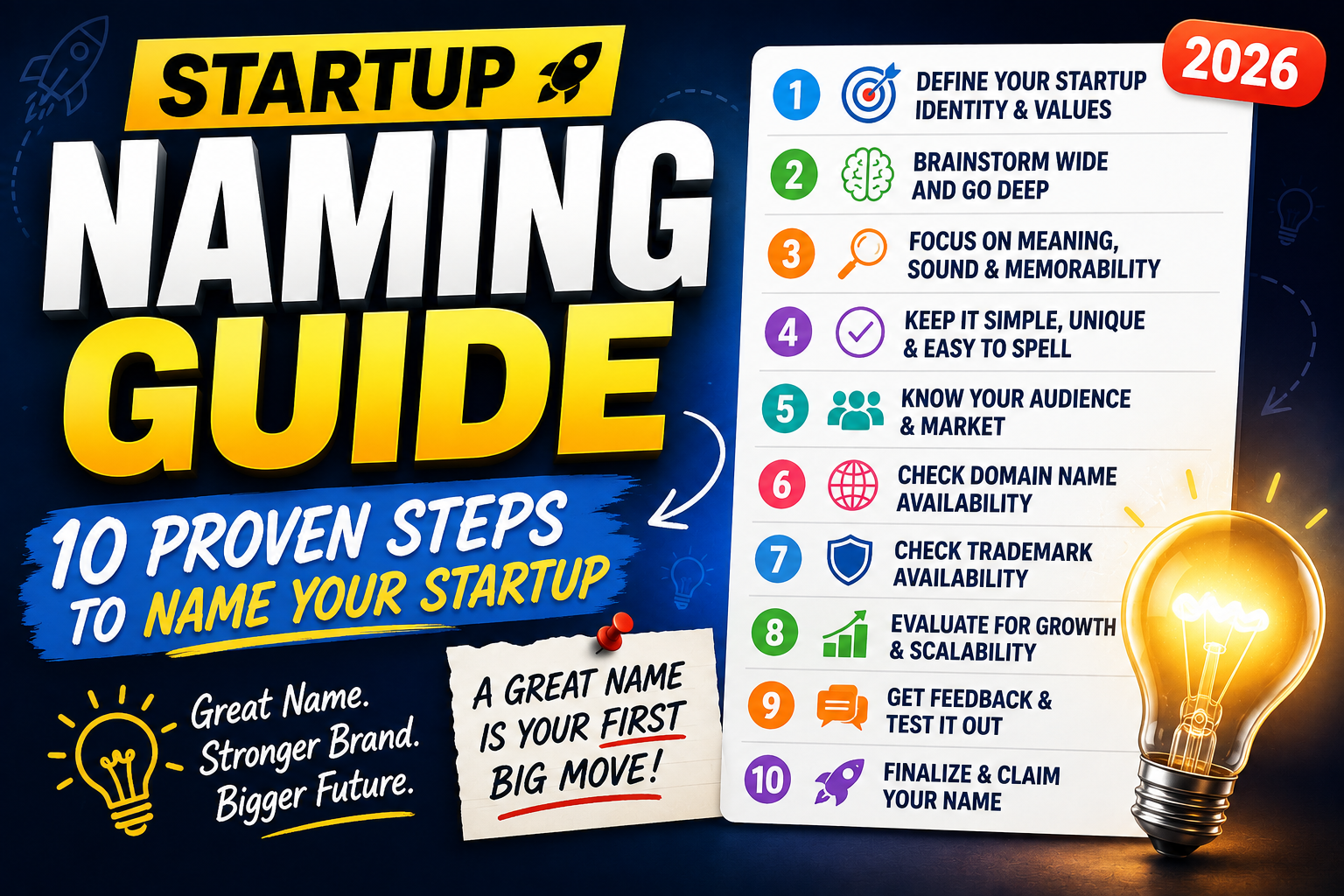
Your 10-Step Startup Naming Checklist
Define Your Strategy
Vision, audience, personality, funding trajectory, global plans. Write a one-page creative brief.
Choose Your Name Type
Suggestive, abstract, compound, or descriptive. Match the type to your startup’s ambitions.
Generate 100+ Ideas
Use our startup name generator, word combinations, metaphor mapping, and language exploration.
Apply the Startup Name Scorecard
Rate on memorability, pronounceability, spellability, distinctiveness, scalability, domain potential, brand fit, and visual potential.
Verify Domain + Social Availability
Check .com first. Explore alternatives with our domain suggestions tool. Secure social handles.
Conduct Trademark Search
USPTO, Google, Crunchbase, domain registrars. Consult an IP attorney for final clearance.
Test with Real People
Radio test, investor test, 10-person test, language test, 72-hour test on your top 3 finalists.
Explore Domain Options
If .com is unavailable, use modifiers, alternative TLDs, or negotiate to buy the domain.
Learn from Successful Startups
Study how Airbnb, Stripe, Notion, and Slack approached naming. Apply their patterns.
Register, Secure, Protect
Register domain immediately. Secure all social handles. File for trademark. Build brand guidelines.
Conclusion: Your Startup Name Is Out There
Naming your startup is one of the first — and