Why Learning How to Choose a Business Name Matters
Your business name is the first thing customers hear. It’s on your website, your business cards, your social media profiles, and in every conversation about your brand. Learning how to choose a business name isn’t just a creative exercise — it’s one of the most consequential business decisions you’ll make.
Research shows that consumers form judgments about a brand’s trustworthiness, sophistication, and excitement within seconds of hearing its name. A strong business name builds credibility instantly. A weak one creates friction — confusion, forgetfulness, even distrust.
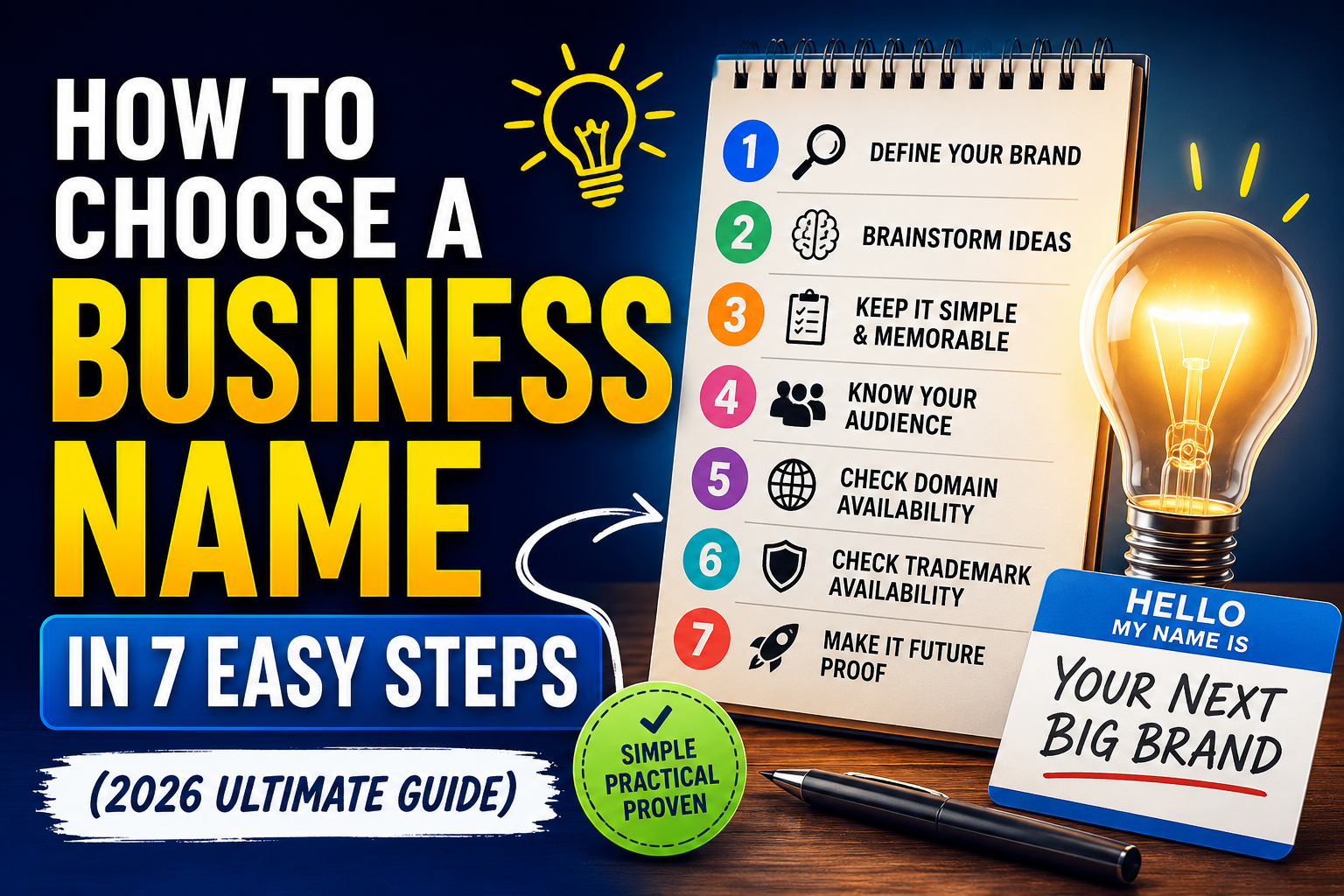
This guide walks you through exactly how to choose a business name using a proven 7-step framework. By the end, you’ll have a shortlist of brandable, available names — and the confidence to pick the right one.
Step 1: Define Your Brand Strategy Before You Brainstorm
Most people start their journey of how to choose a business name by brainstorming random words. That’s backwards. The strongest business names emerge from strategy, not randomness.
Answer These Questions First:
- What’s your mission? What change are you creating in the world? Your name should feel aligned with your purpose.
- Who’s your audience? A name that appeals to Gen Z gamers won’t work for corporate B2B clients. Define your ideal customer first.
- What’s your brand personality? Are you professional or playful? Luxurious or accessible? Rebellious or reliable? Your name should telegraph your tone.
- What are your non-negotiables? Must the .com be available? Does the name need to work internationally? Define constraints early.
Create a One-Page Creative Brief:
Write down: your mission, target audience, brand personality traits (3-5 adjectives), competitors’ names (so you know what to avoid), and any words or themes you want your name to evoke. This brief becomes your filter for evaluating every business name idea later.
Step 2: Understand the Four Types of Business Names
Before generating business name ideas, understand the strategic options. Most business names fall into one of four categories. Each has strengths and trade-offs:
| Type | Description | Examples | Best For |
|---|---|---|---|
| Descriptive | Says exactly what you do | General Motors, The Home Depot, PayPal | Local businesses, professional services, B2B |
| Suggestive | Evokes a feeling or benefit | Airbnb, Shopify, Slack, Pinterest | Startups, consumer brands, tech companies |
| Abstract / Invented | Made-up words with no existing meaning | Google, Spotify, Verizon, Kodak | Disruptive startups, global brands |
| Compound / Blended | Two words merged or combined | Facebook, YouTube, Netflix, Instagram | Consumer tech, accessible brands |
Suggestive and abstract names often work best for startups that need to stand out and build a unique brand identity. Descriptive names can serve local businesses where clarity matters more than creativity. Understanding these categories is essential for how to choose a business name strategically.
Step 3: Generate 50-100+ Business Name Ideas
Now the creative part. The key to how to choose a business name successfully is quantity before quality. Generate broadly before you narrow. Your perfect name is probably hiding in option #73.
Ways to Generate Business Name Ideas:
🤖 AI Name Generator
Describe your business in plain English using our free business name generator. The AI understands context, tone, and category — producing suggestions across descriptive, suggestive, and abstract styles.
🧠 Word Association
Start with words related to your industry, values, and benefits. Branch out into synonyms, metaphors, and related concepts. “Cloud” might lead to “Sky,” “Nimbus,” “Stratus,” “Atmos.”
🔤 Word Combination
Combine two relevant words. Prefix + Suffix. Adjective + Noun. Verb + Noun. Many iconic brand names emerged from simple combinations: “Micro” + “Soft,” “Face” + “Book,” “You” + “Tube.”
🌍 Foreign Language Inspiration
Look up key brand attributes in other languages. “Nike” is the Greek goddess of victory. “Volvo” means “I roll” in Latin. Be careful with pronunciation and cultural context — but inspiration can come from anywhere.
Step 4: Filter Using the SMILE and SCRATCH Framework
Once you have a long list of business name ideas, it’s time to filter. Brand strategists often use two complementary frameworks for how to choose a business name:
SMILE — What You Want in a Business Name:
- Suggestive — It evokes something meaningful about your brand
- Meaningful — It connects to your mission, values, or customer benefit
- Imagery-rich — It paints a picture or creates a mental image
- Legs — It has room to grow; it won’t limit future expansion
- Emotional — It makes people feel something
SCRATCH — What to Avoid in a Business Name:
- Spelling-challenged — Hard to spell after hearing it
- Copycat — Too similar to competitors or existing brands
- Restrictive — Too narrow for future growth
- Annoying — Forced, awkward, or trying too hard
- Tame — Boring, generic, blends into the noise
- Curse of knowledge — Only makes sense if you already know the backstory
- Hard to pronounce — Creates friction in conversation
Score each name on your list against SMILE (1-5 points per letter, max 25). Then check for SCRATCH issues. Eliminate anything that scores low or triggers multiple SCRATCH concerns.
Step 5: Check Availability — Domain, Social, and Trademark
This is where many people stumble when learning how to choose a business name. They fall in love with a name before checking if it’s actually available. Don’t make that mistake. Availability comes before attachment.
Three Availability Checks:
🌐 Domain Name
Check .com first — it’s still the gold standard for credibility and direct navigation. If .com is taken, consider .co or .io for tech businesses. Use our free domain checker to scan multiple TLDs instantly.
📱 Social Media Handles
Consistency across platforms matters. Check Twitter/X, Instagram, Facebook, LinkedIn, TikTok, and YouTube. Even platforms you don’t plan to use yet — secure handles now. Our social handle checker checks all platforms at once.
⚖️ Trademark Database
Search the USPTO TESS database (US) or your country’s trademark office. Look for exact matches and similar-sounding names in your industry. A clean preliminary search is promising but not definitive — consult a trademark attorney for commercial use.
Step 6: Test Your Shortlist Before You Commit
You’ve filtered your list down to 3-5 finalists. Now, before the final decision, test them in the real world. This step in how to choose a business name catches issues you won’t notice on a spreadsheet.
The Five Tests:
The Radio Test
Say the name out loud as if you heard it on a podcast. Can you spell it correctly? Could someone else? If hearing the name doesn’t lead to finding you online, you have a problem.
The Google Test
Search the exact name. What shows up? Competitors? Unrelated businesses? Negative associations? You want a clean search landscape — or at least one you understand.
The 5-Person Test
Show your top names to 5 people in your target audience. Don’t explain anything — just show the name and ask: “What kind of business do you think this is?” Watch their facial expressions. Confusion is a red flag.
The Language Test
Run your top names through native speakers in any markets you plan to serve. The classic cautionary tale: Chevy Nova — “no va” means “doesn’t go” in Spanish. A quick check prevents costly embarrassment.
The 48-Hour Test
Live with your top choice for 48 hours. Say it. Write it. Imagine it on a website, a storefront, a pitch deck. Do you still like it after sitting with it? Initial excitement fades; genuine fit endures.
Step 7: Score, Compare, and Make the Final Decision
You’ve generated, filtered, checked availability, and tested. Now it’s decision time. Use our brand name scorer to evaluate your finalists on memorability, pronunciation ease, uniqueness, and brandability.
Final Decision Matrix:
| Criteria | Weight | Name 1 | Name 2 | Name 3 |
|---|---|---|---|---|
| Memorability | 25% | |||
| Brand Fit | 20% | |||
| Domain Availability | 20% | |||
| Pronunciation Ease | 15% | |||
| Uniqueness | 10% | |||
| Growth Potential | 10% | |||
| TOTAL | 100% |
Score each name 1-10 on each criterion. Multiply by the weight. The highest total wins. If your gut disagrees with the math, explore why — sometimes your intuition is catching something the framework missed.
Common Mistakes When Learning How to Choose a Business Name
Mistake #1: Falling in Love Before Verifying Availability
You find the perfect name. You can already visualize the logo. Then you discover the .com domain was registered in 2004 and is parked on a $5,000 buy-it-now page. Heartbreak. Fix: Check domain and social availability at the same time you’re generating ideas. Only allow yourself to get excited about names that are actually available.
Mistake #2: Choosing a Name That’s Too Narrow
“Portland Organic Dog Grooming” limits you when you want to expand to cats, move to Seattle, or add pet supplies. Fix: Ask: “Will this name still make sense if we expand our products, services, or locations?” Keep the name broad enough to grow with you.
Mistake #3: Prioritizing Cleverness Over Clarity
Obscure puns. Complex wordplay. Spelling that requires explanation. If people don’t get your business name without a footnote, they won’t remember it — and they definitely won’t recommend it to friends. Fix: Test your name on people outside your industry. If they furrow their brow, simplify.
Mistake #4: Copying Competitors
Two “Uber for X” startups with rhyming names. Three SaaS companies ending in “-ify.” When your name sounds like everyone else’s, customers can’t tell you apart. Fix: Research competitor names specifically to avoid them. Your name should occupy its own mental space.
Mistake #5: Skipping the Trademark Search
You launch. You grow. Then a cease-and-desist letter arrives from a company with a similar name in a related industry. Rebranding after launch is expensive and confusing. Fix: Search trademark databases before finalizing. When in doubt, consult an intellectual property attorney.
Tools to Help You Choose a Business Name
NameSpark offers a complete suite of free tools specifically designed for how to choose a business name efficiently:
🤖 Business Name Generator
Describe your business and get AI-powered name suggestions across multiple styles.
📊 Brand Name Scorer
Rate your business name ideas on memorability, uniqueness, and brandability.
🔍 Domain Checker
Instantly check .com, .co, .io, .net, .org, and country TLDs for your business name.
📱 Social Handle Check
Verify your business name availability across Twitter, Instagram, Facebook, and more.
⚡ Name Comparison
Compare your shortlisted business names side by side with all availability data.
Real-World Examples of Great Business Names
Studying successful business names reveals patterns. Here are examples across different name types and what makes them work:
| Business Name | Type | Why It Works |
|---|---|---|
| Stripe | Suggestive | Short, modern, tech-forward. Suggests simplicity (a stripe is clean and minimal). Easy to say, spell, and remember. |
| Airbnb | Compound | “Air” + “B&B” (bed and breakfast). Describes the original concept while being short and brandable. Three syllables, easy to pronounce globally. |
| Notion | Suggestive | Evokes ideas, thinking, organization. Feels smart but not pretentious. Two syllables. The .com redirects from a .so domain — a common startup pattern. |
| Warby Parker | Invented/Founder-inspired | Combines two names from Jack Kerouac characters. Sounds established and literary. Appeals to a creative, intellectual audience. |
| Slack | Suggestive | Short, punchy, memorable. Suggests ease and reduced friction. Also works as an acronym: “Searchable Log of All Conversation and Knowledge.” |
Frequently Asked Questions About How to Choose a Business Name
How long should a business name be?
Research suggests 2-3 syllables is optimal for brand recall. Most iconic business names (Apple, Nike, Google, Zoom, Stripe) fall in this range. Longer names aren’t automatically bad — “Salesforce” works at 3 syllables — but every extra syllable makes memorability slightly harder.
Should I use my own name for my business?
It depends on your goals. Founder-named businesses (Deloitte, McKinsey, Johnson & Johnson) convey personal reputation and trust — excellent for consulting, law, and professional services. But they’re harder to sell, harder to scale beyond the founder, and don’t tell customers what you do. If you plan to eventually exit, a brand name may serve you better. Learn more about this in our complete naming guide.
What if the .com domain is taken for my business name?
This is the most common frustration when figuring out how to choose a business name. Options include: trying alternative TLDs (.co, .io for tech; .org for nonprofits), adding a modifier (get + name, name + app, try + name), buying the domain from the current owner (potentially expensive), or choosing a different name. If your business relies heavily on word-of-mouth and direct navigation, the .com is worth prioritizing. Use our domain checker to explore options.
How do I know if my business name is trademarked?
Start with a free search on the USPTO TESS database (United States), EUIPO (European Union), or your country’s trademark office. Search for exact matches and similar-sounding names in your industry category. A clean preliminary search is encouraging but not definitive — for commercial use, always consult a trademark attorney for a comprehensive clearance search.
Can I change my business name later if I make a mistake?
Yes, but it’s expensive and disruptive. Rebranding costs include new domains, updated marketing materials, customer communication, legal filings, and lost brand equity. It’s far better to invest time upfront learning how to choose a business name correctly than to rebrand later. That said, many successful companies have rebranded — Google started as “BackRub,” Nike was “Blue Ribbon Sports,” and Amazon was originally “Cadabra.” If you must change, you’re in good company.
Your 7-Step Action Plan for How to Choose a Business Name
Write Your Creative Brief
Define your mission, audience, brand personality, and constraints. This is your decision-making filter.
Choose Your Name Type
Decide whether descriptive, suggestive, abstract, or compound best fits your brand strategy.
Generate 50-100+ Ideas
Use our business name generator, word association, and combination techniques. Quantity over quality at this stage.
Filter with SMILE + SCRATCH
Score names on the SMILE framework. Eliminate anything that triggers SCRATCH red flags.
Verify Availability
Check domains, social handles, and trademark databases. Only proceed with names that pass all three.
Test Your Shortlist
Run the radio test, Google test, 5-person test, language test, and 48-hour test on your top 3-5 finalists.
Score, Decide, and Register
Use our brand name scorer for the final comparison. Then register your domain and secure social handles immediately.
Conclusion
Learning how to choose a business name is a process — not a lightning strike. It requires strategy, creativity, rigorous filtering, and the discipline to verify availability before emotional attachment sets in. But when you find the name that’s memorable, brandable, available, and aligned with your vision — it’s worth every minute of the search.
The best time to start is now. Generate your first batch of business name ideas. Apply the frameworks in this guide. Check availability. Test with real people. And trust the process.
Start generating business name ideas now → — free, instant, no account required.
Then use our brand name scorer and domain checker to evaluate and secure your top picks. Your business name is out there. Let’s find it.